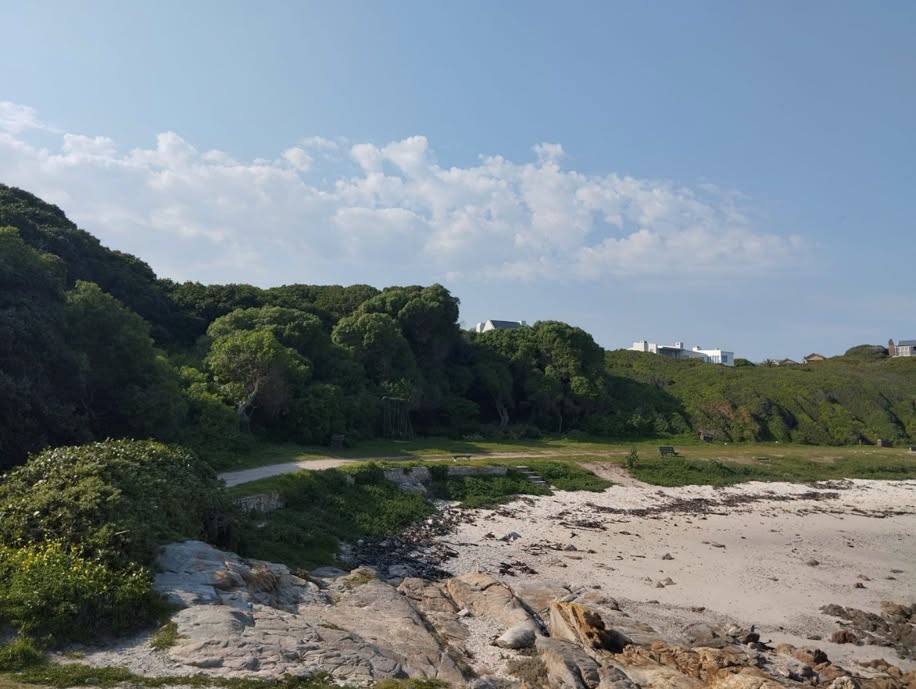

Overstrand Municipality is aware of residents’ concerns about the deteriorating grass, collapsed embankments and washed-away steps at Stanford’s Cove in De Kelders near Gansbaai.
Stanford’s Cove is a public open space enjoyed by residents and visitors, and the Municipality recognises the importance of addressing the challenges and ensuring that the area remains safe.
Recent storms and unusually high seas have caused significant erosion along many parts of the Overstrand coastline, including Stanford’s Cove. The cove is a small “pocket beach” where sand naturally moves within the area. During storms, sand can be moved away from parts of the beach and upper shoreline. Under calmer conditions, some of this sand may return naturally, although the beach may not recover to exactly the same shape.
As part of the process of finding solutions to ensure that Stanford’s Cove remains a safe and usable public space, the Municipality requested input from the Western Cape Government’s Department of Environmental Affairs and Development Planning (DEA&DP). The Department’s Coastal Management team conducted a site inspection on 29 July 2026 and provided recommendations to the Municipality.
Following the site visit and review of the available information, Coastal Management advised that the situation is not considered an emergency and that there is currently no immediate risk to life requiring urgent intervention.
The Municipality will therefore not proceed at this stage with mechanically reshaping the beach or placing rocks as an erosion-control measure. Such interventions could interfere with the natural movement of sand and potentially cause further erosion elsewhere in the cove.
For now, the damaged staircase and eroded paths have been closed and barricaded for public safety. The beach will remain open, as there are four to five other access points available from the grassed area.
The damaged staircase will not automatically be rebuilt in its current position. If replacement access is required, the Municipality will investigate options that are better suited to the coastal environment and allow for the natural movement of sand.
What happens next?
The Municipality’s Environmental and Conservation Division, with input from the Infrastructure and Community Services Directorates, will monitor the area and consider:
* the stability and safety of the affected embankment;
* safe and suitable access to the beach;
* options for restoring vegetation and helping to retain sand;
* the effect of stormwater flowing towards the beach; and
* longer-term rehabilitation options for the area.
The Municipality will also monitor the area and review historical photographs and information to better understand how the site has changed over time.
Any future work involving sand movement, earthworks, rock placement or other coastal stabilisation measures will be discussed with the relevant environmental authorities to determine whether environmental authorisation or other approvals are required before work can begin.
Residents are requested to:
* keep away from steep and potentially unstable erosion areas;
* supervise children and pets in the affected area;
* observe all temporary barriers and warning signs;
* avoid removing sand, rocks or vegetation; and
* not place rubble, soil, rocks or other material on the beach without municipal approval.